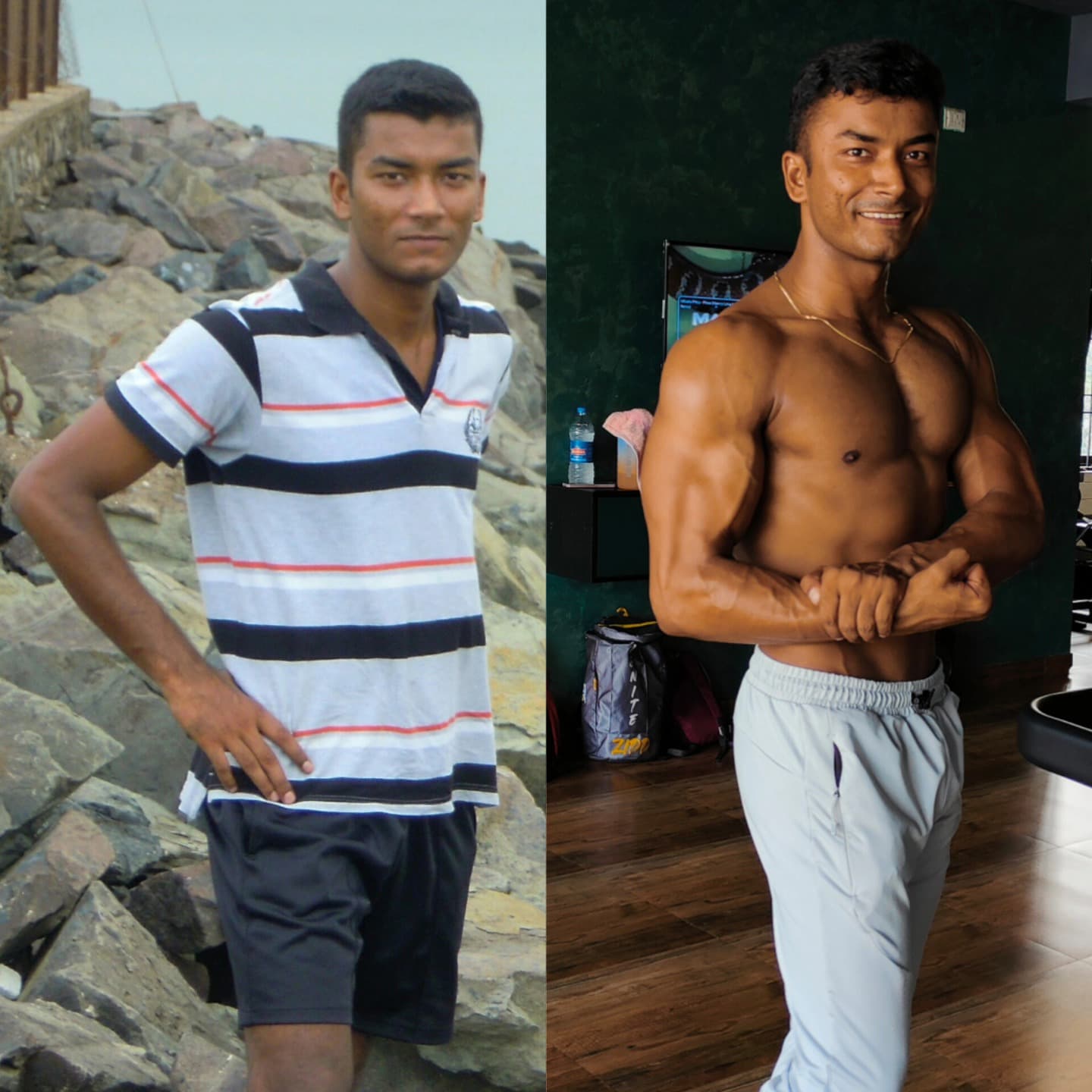
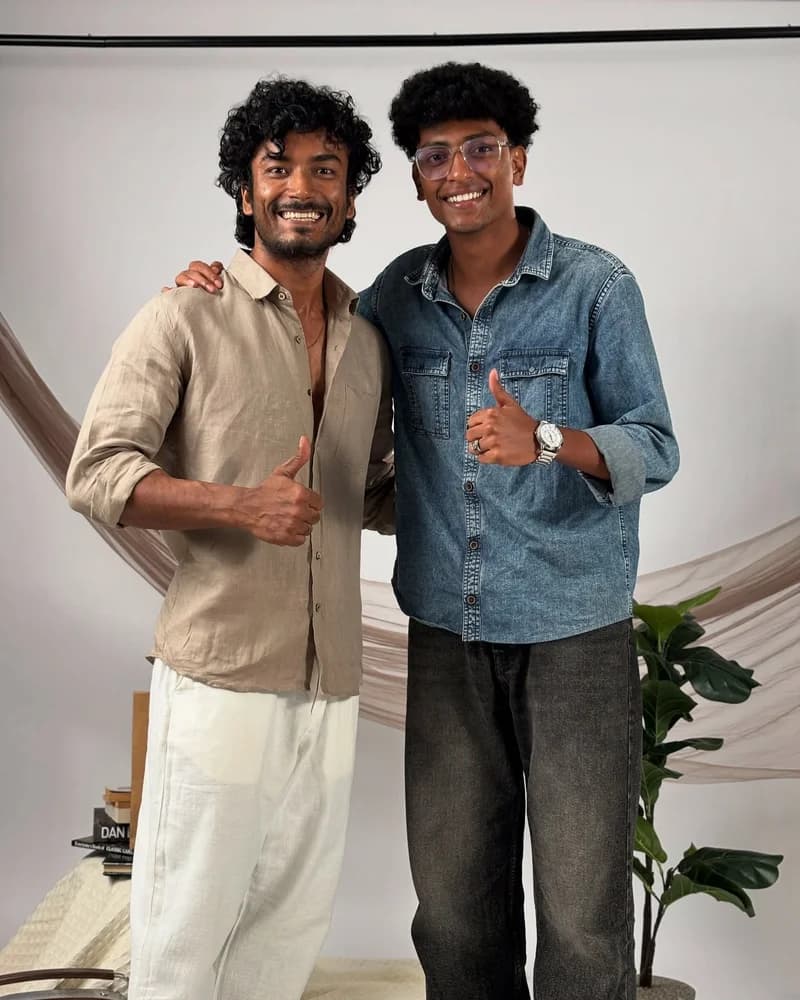
Avyaansh, the pics are 12 years apart. Keep hustling!
I keep two photos on my phone. Not for motivation — I'm past needing motivation. I keep them as evidence. Evidence that the human body, without any chemical assistance, without any paid coaching, without any genetic advantage, can transform beyond recognition if you simply refuse to quit for long enough.
The first photo: a skinny kid. Narrow shoulders. Flat chest. Arms like rope. No muscle definition whatsoever. The kind of body that gets ignored in every room. The kind of body that made me avoid mirrors.
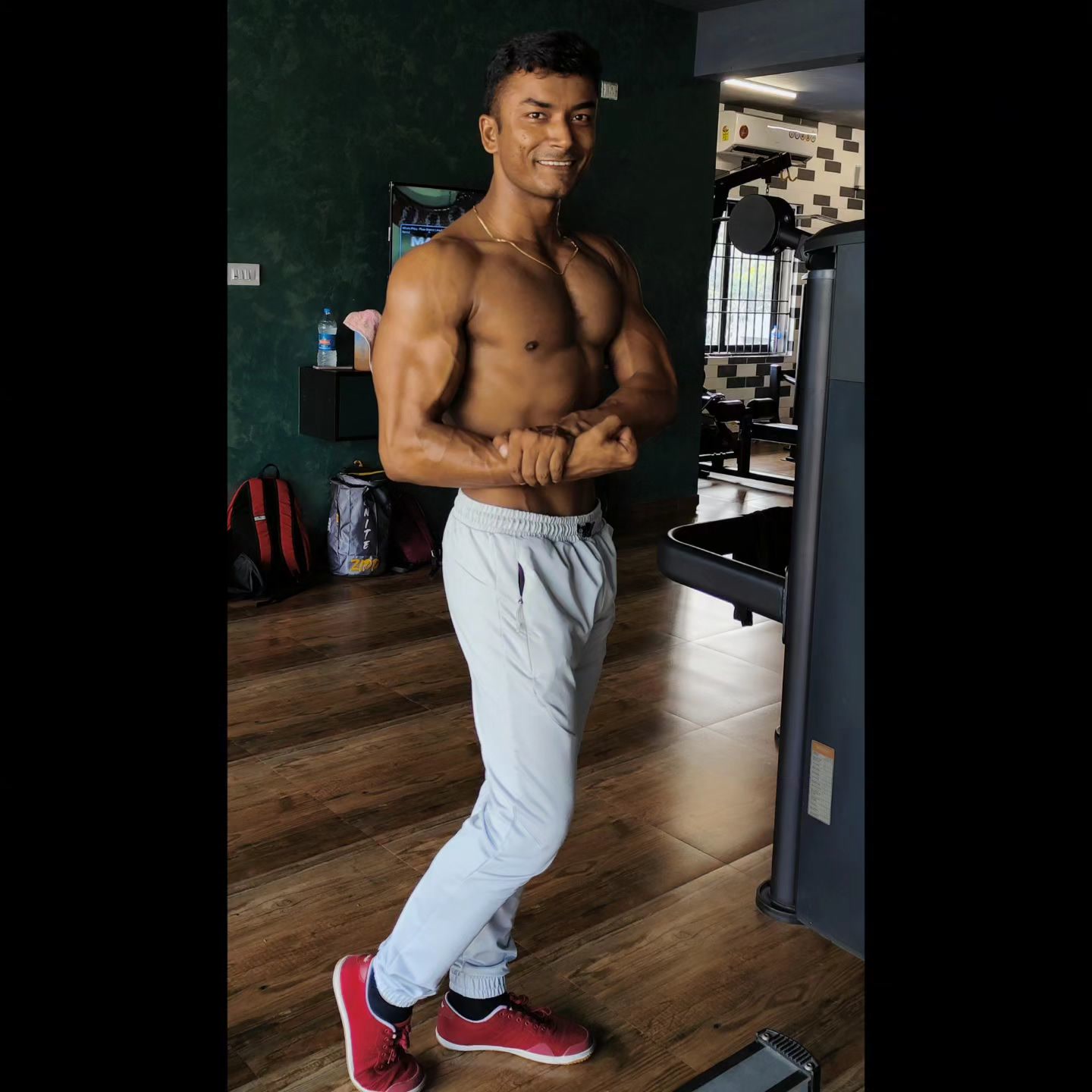
The second photo: a man who does handstands, front levers, backflips, muscle-ups, and handstand push-ups. Natural. Twelve years of compounding. Check the natty double biceps pose. 🔱
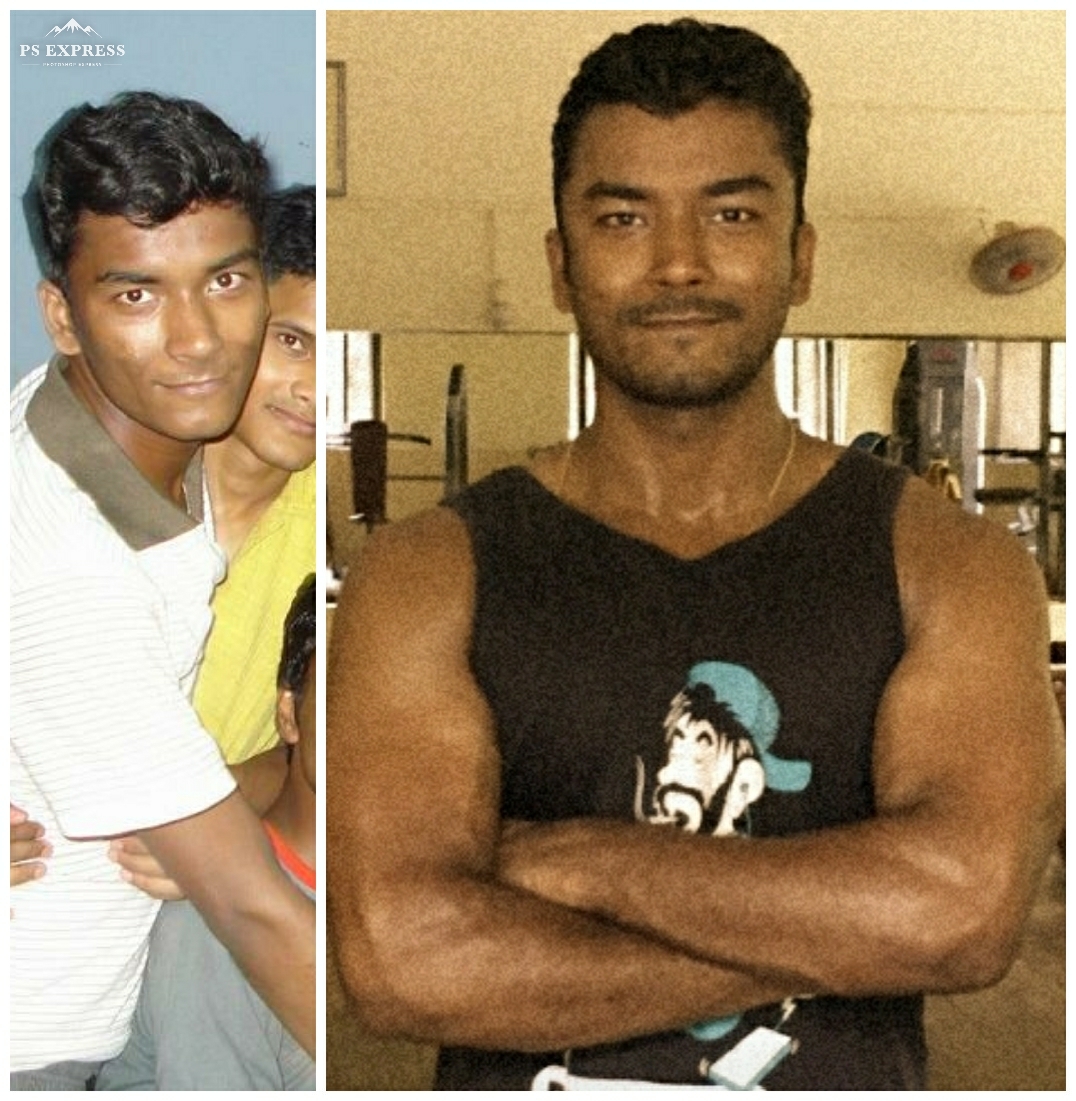
No steroids. No coaching. No shortcuts. Just twelve years of showing up.
Year 1-2: The Skinny Start
I weighed about 58kg when I joined the Navy. At 5'8", that's skinny by any definition. My wrists were thin enough to wrap one hand around. My chest was concave. I had the upper body of someone who had never touched a pull-up bar — because I hadn't.
The first year was humbling. I couldn't do five proper pull-ups. My push-ups were shallow and shaky. I'd see other recruits cranking out sets with perfect form and wonder what was wrong with me.
Nothing was wrong with me. I was starting from zero. And starting from zero means the first year is nothing but building a base. No visible results. No dramatic before-and-after for month one. Just slow, painful adaptation of muscles, tendons, and connective tissue that had never been asked to do anything.
By the end of year two, I could do 15 pull-ups, 40 push-ups, and 20 dips. I'd gained maybe 4kg. Barely noticeable to anyone else. But I could feel the difference. My shirts fit different. My posture changed. Something was happening under the surface.
Year 3-5: First Real Skills
Year three is when the compound effect announced itself. My first muscle-up. One single, grinding, ugly muscle-up that I screamed about like I'd won a championship. That one rep opened a door to a world I didn't know existed.
Suddenly I wasn't just "doing pull-ups." I was doing calisthenics. I started learning about progressions, about skill work, about the difference between training for strength and training for skills. My workouts changed from "do as many reps as possible" to "practice this specific movement pattern until it clicks."
By year four, I could hold an L-sit for 15 seconds, do sets of muscle-ups, and I started my handstand journey. My bodyweight was up to 68kg — ten kilograms of lean mass gained over four years. Still skinny by gym standards. Still unremarkable in a group photo. But the trajectory was undeniable.
Year five brought my first handstand holds against the wall for over 30 seconds. My shoulders were visibly different — rounder, capped, the kind of shoulders you only get from years of overhead pressing with your own bodyweight. The before-and-after from year one to year five was the first time I looked at photos and thought: "This is working."
Year 5-8: The Plateau Years
I'm going to be honest about something that transformation posts on Instagram never show you. Years five through eight were the hardest. Not because the training was harder — it was actually more enjoyable than ever. But because visible progress slowed to a crawl.
The first five years gave me dramatic changes. Skinny to athletic. Weak to capable. Zero skills to muscle-ups and wall handstands. But from year five to year eight, the changes were subtle. A little more muscle density. Slightly better definition. A few more seconds on my front lever hold. Things that I could measure but couldn't see in the mirror.
This is where most people quit. They expect linear progress forever, and when the curve flattens, they think they've hit their genetic ceiling. They try a new program. A new diet. A new supplement. When none of that works, they either quit entirely or reach for the needle.
I refused both options. I kept training. I trusted the process. And I learned to measure progress in skills, not mirror images. Can I hold the front lever longer? Can I do more handstand push-ups? Is my muscle-up cleaner? These became my metrics, and they kept me honest during the years when the mirror had nothing new to show.
Compounding all the way. The sooner you start, the better the picture. But understand this — compounding is invisible for years before it becomes undeniable. The plateau is not the end. The plateau is where champions are forged.
Year 8-12: Everything Clicks
Year eight is when I added hybrid training — weights alongside calisthenics. The 140kg deadlift came. The weighted pull-ups came. And suddenly, my bodyweight skills jumped to a new level because my absolute strength base had expanded.
Freestanding handstand: achieved. Front lever: full hold achieved. Backflip: learned and landed. Handstand push-ups: 7 in one set. Muscle-ups: clean sets of 5.
My bodyweight settled at about 77kg. Nineteen kilograms heavier than where I started, and all of it functional muscle that I use every single day. Not gym-show muscle. Not beach muscle. Muscle that lets me flip, hold, press, and control my body in ways that most people think require years of gymnastics training from childhood.
The photos from year twelve next to the photos from year one don't look like the same person. Not even close. And that's the point. Twelve years of natural training doesn't give you quick results. It gives you permanent results. Results that are woven into your tendons, your neural pathways, your identity.
What Worked: The Short List
Consistency over everything. I trained 5-6 days a week for twelve years. Not perfectly. Not always with the right program. But consistently. The worst program done consistently beats the best program done sporadically. Show up. That's 80% of the game.
Progressive skill goals. I always had a skill I was chasing. First it was the muscle-up. Then the handstand. Then the front lever. Then the backflip. Having a specific skill goal gives your training direction and your progress a measurable outcome. "Get stronger" is vague. "Hold a front lever for 5 seconds" is concrete.
Real food. I eat Indian food. Dal, rice, roti, eggs, paneer, chicken, dahi, ghee, vegetables. Nothing exotic. Nothing imported. Nothing that costs more than what a normal Indian family spends on groceries. The best nutrition plan is the one made from foods you can find in your local market and eat for decades without getting bored.
Sleep. The one "supplement" I always return to. Seven hours minimum, eight ideal. When I sleep well, I grow. When I don't, I stagnate. After twelve years, this is the single most underrated variable in my transformation. Not creatine. Not whey protein. Not BCAAs. Sleep.
What Didn't Work: The Honest Failures
3-month transformation programs. I tried at least four of them over the years. "12-Week Shred." "90-Day Body Recomp." "Summer Body Challenge." All of them produced short-term results that evaporated within weeks of completion. Because the programs were designed for adherence, not for life. You can't build a twelve-year body in twelve weeks. Stop trying.
Excessive cardio. There was a phase — about year three — where I thought more running would lean me out. I was doing 40+ kilometers a week. I got lean, yes. I also got small, weak, and my calisthenics skills regressed. Excessive cardio in a calorie deficit is muscle murder. I learned this the hard way and never repeated the mistake.
Copying bodybuilder splits. Chest day, back day, leg day, arm day, shoulder day. The classic "bro split" that every gym-goer in India follows. It works for bodybuilders on gear who can recover from high-volume isolation work. For a natural athlete, it's too much volume per muscle group with too little frequency. I switched to full-body and upper/lower splits and never looked back.
The Anti-Steroid Stand
I need to say this clearly because the fitness industry in India — and globally — is drowning in chemical enhancement being sold as "hard work."
If someone convinces you to stick the needle up your bum just to get those quick gains — remember, those gains vanish that much faster and they leave your hormones wrecked.
I have seen young men in their twenties with the testosterone levels of sixty-year-olds because they ran a steroid cycle to look good for a wedding or a beach trip. Their endocrine system was damaged, their libido destroyed, their mood unstable — all for gains that disappeared within months of stopping.
My transformation took twelve years. Twelve years. That's the price of natural. And I'd pay it again without hesitation because every kilogram of muscle on my body is honestly earned, permanently built, and came with zero side effects.
Stay natural. Keep those gains. The slow road is the only road that doesn't dead-end.
You've been sold a lie that transformation happens in weeks. It doesn't. Real transformation — the kind that reshapes your body AND your identity — happens over years. Embrace the timeline. Trust the compound effect. And never, ever trade your health for shortcuts.
Avyaansh, I'm posting this so you can find it when the time comes. Twelve years apart. Two photos. One body. No shortcuts. This is your inheritance — not the muscle, but the proof that patience builds things that nothing can tear down.
To the Gainz. 🦾 Har Har Mahadev. 🔱

